


Table of Contents
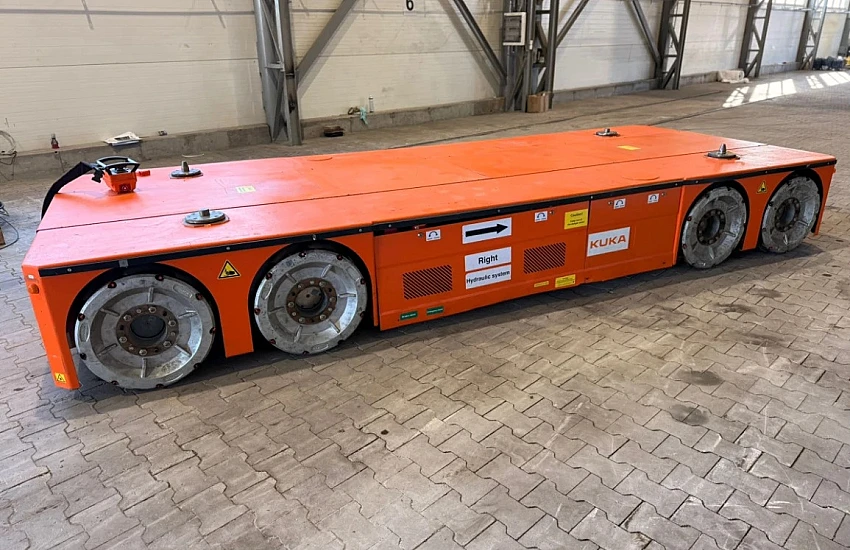
The KUKA KoM-18000-UTV-D575 is one of the most powerful heavy-duty mobile platforms designed for heavy-duty work. Designed for heavy industry, it combines stability, mobility, and the ability to integrate with a robot or technology module. This solution is designed for applications where traditional stationary robots fail—in large-scale applications, challenging environments, and tasks requiring complete flexibility.
1. Introduction
The KUKA KoM-18000-UTV-D575 is one of the most unusual designs ever created by KUKA. It's not a classic robot or a typical industrial vehicle. It's a heavy-duty mobile platform, designed to operate in environments where traditional robotic cells are too limited. It excels in applications where components are too large, too heavy, or require operation in multiple locations within a facility, rather than at a single fixed point.
This model wasn't a catalog product—it was created as a project solution tailored to the needs of large-scale plants. The design combines a robust chassis with the ability to mount a robot, a technology module, or a towing system. In installations, it often worked with an industrial panel, an operator terminal, and a service panel, enabling full diagnostics, configuration, and even remote control of the platform.
The KoM-18000 was a milestone in the development of KUKA mobile systems, designed even before the emergence of modern AMRs. It demonstrates how early the company considered mobility as a component of future robotic technology.
2. Origins of the Design – Mobile Robotics Before the Era of AMRs
KUKA developed the KoM-18000-UTV-D575 at a time when industry began to require mobile solutions for handling large components. Before the emergence of today's autonomous mobile robots (AMRs), manufacturers experimented with heavy-duty platforms that could move a robot or a tool instead of a workpiece.
The KoM-18000 was part of these early experiments: it was designed to combine a stable chassis, the ability to integrate a robot, and high mechanical strength. The design was designed for industries where components are too heavy to be moved—therefore, the platform would approach the component, not the other way around. Combined with a control module and advanced control functions, the system could operate in both automatic and offline modes.
3. Design and Construction of the KoM-18000-UTV-D575
The KoM-18000-UTV-D575 is a robust, mobile work platform designed for heavy-duty work. Its design focuses on stability, durability, and the ability to mount various tools or an industrial robot.
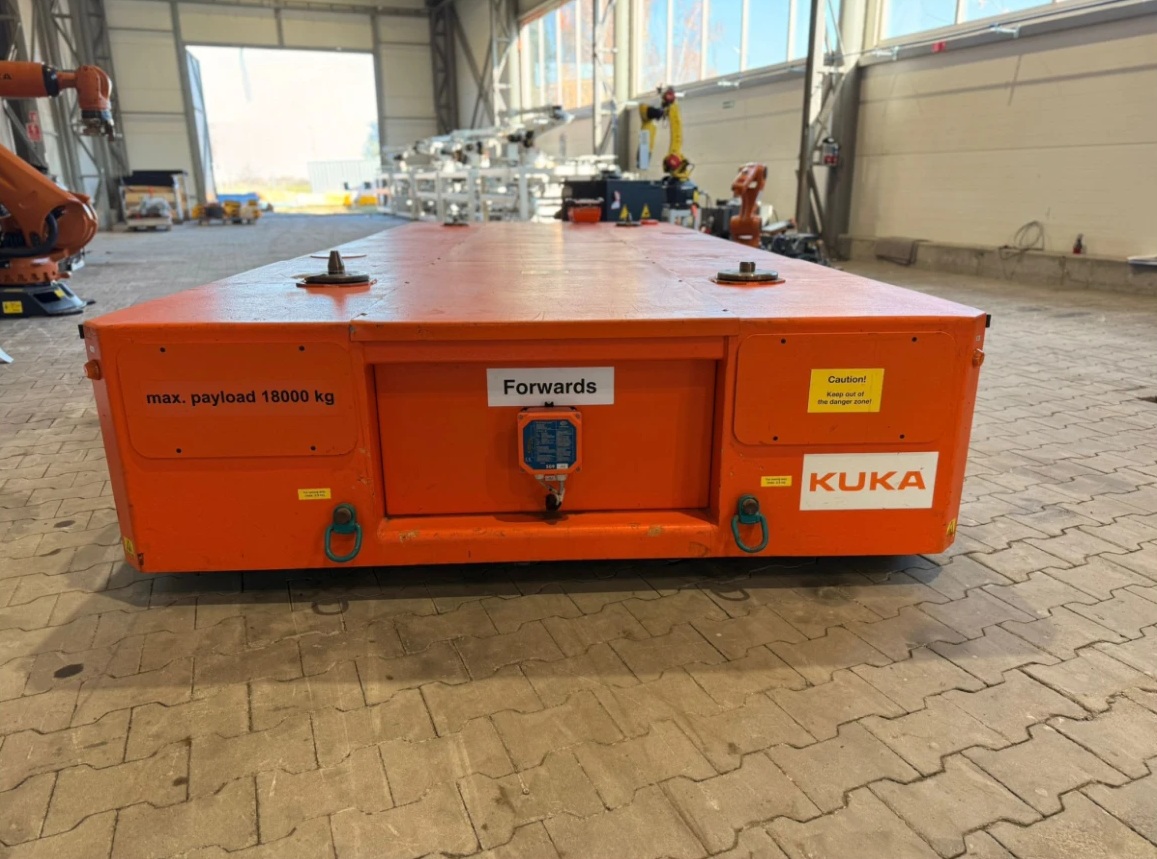
Serial number (Werk-Nr): 161 015
Year of manufacture: 2008
The entire KoM-18000-UTV-D575 structure is divided into main technical sections that determine stability, mobility, and integration options:
- Chassis and Mobile Base
The platform rests on a heavy steel frame weighing approximately 6 tons. This design ensures rigidity and vibration resistance, which is crucial for robot integration or when towing large components.
- Drive and Traction System
The model is equipped with an industrial chassis capable of transporting loads up to 2.5 tons. The drive and control system are designed to allow the platform to precisely position itself in the work area. This works even under load when the operator uses the operator module or controls the axes.
- Integration with a Robot or Tool
The upper part of the structure allows for the installation of:
- a KUKA industrial robot,
- a special technology module,
- a towing system, or a gripper.
- Power Supply and Control
The device utilizes control components used in KUKA robots from that era. This emphasizes reliability, easy integration, and the availability of service parts on the market. Many installations also utilize a service panel, which facilitates diagnostics, monitoring, and parameter configuration.
4. Heavy Industry Applications
The KoM-18000-UTV-D575 was designed for environments where traditional stationary robots have limitations. Its mobility, weight, and the ability to connect accessories make it well-suited for working with large components. It is also useful where the station must "drive" to the workpiece, rather than the other way around.
In practice, the platform finds applications in several main areas:
- Transport and Handling of Large Components
The platform can maneuver in environments with heavy structures, frames, steel components, and machine modules.
This mobility allows for direct access to the component instead of sending it to subsequent stations.
- Mobile Workstation
The KoM-18000 can function as a mobile technological station – for example, with a mounted robot, tool, or measurement system. In this mode, the platform often works with an operator terminal and remote control functions.
- Steel and Construction Industry
Thanks to its high stability and load resistance, the design is suitable for working on:
- large steel elements,
- prefabricated elements,
- thick-walled components,
- structural structures.
This is an environment where a mobile platform has a real advantage over stationary robots.
- Energy and Infrastructure Production
In industries such as energy, railways, offshore, and heavy industry, the device can be used for a variety of tasks. It can serve as a base for welding, assembly, tool handling, and measurement. It also enables the implementation of processes that are difficult to transfer to traditional lines.
5. Summary
The KUKA KoM-18000-UTV-D575 is designed for plants that work with large, heavy components and require a workstation capable of mobile operation. The stable base and robot integration options make this tool highly practical. It offers support for functions such as axis control, path editing, and offline operation. It also features extensive operator panels and modules, making it ideal for heavy industry.
It is a rare but exceptionally effective example of the combination of mobility and power—ideal for applications where a traditional stationary robot becomes unnecessary.