

Table of Contents
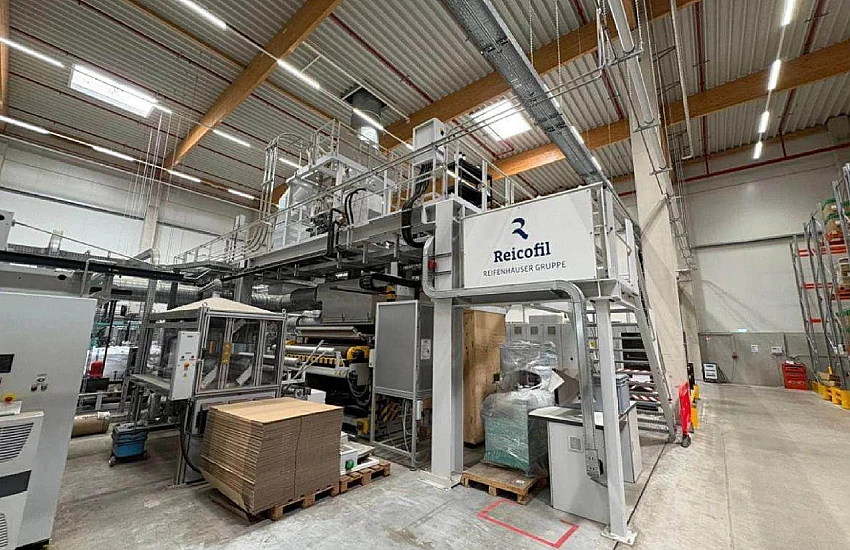
The Reifenhäuser Reicofil MB 1600 is a meltblown line designed for the production of technical nonwovens with stable and repeatable parameters. Below, we present the most important information about the technology, applications, and capabilities of this machine.
1. Introduction – Reifenhäuser's History
Reifenhäuser is a German manufacturer of industrial machinery with over a century of history, dating back to 1879. From its inception, the company has been involved in plastics processing and the development of extrusion technologies, which have become the foundation of modern industrial solutions. Even early on, precision manufacturing and process stability were key.
Over the decades, Reifenhäuser has systematically developed its expertise, responding to the growing industry needs for technical materials. The company has established itself as a global leader in nonwovens, films, and advanced polymer structures. This decades of experience has allowed it to create solutions that are now standard across numerous industries.
The Reicofil brand was introduced as a specialized technological line dedicated to spunbond and meltblown processes. Its development was a response to market demand for reliable, efficient, and repeatable production systems, used in applications such as filtration, medicine, and the technical industry.
2. Meltblown Technology in the Reicofil MB 1600
Meltblown technology is one of the most advanced methods for manufacturing technical nonwovens. It involves forming very thin microfibers from a thermoplastic material, most often polypropylene, using high temperature and hot air jets. This process requires extremely precise parameter control, as even slight variations can affect the material's structure.
Production begins with the plasticization of the polymer in an extrusion system. The plastic granules are melted into a homogeneous form and then directed to the meltblown head. At this critical point, the molten material is stretched by hot air jets, creating microfibers with a diameter much smaller than a human hair.
The formed fibers are randomly deposited on a receiving system, creating a nonwoven structure without the need for weaving or mechanical bonding. This material structure is crucial for its filtration properties and forms the basis for effective particle separation in subsequent applications.
In the Reifenhäuser Reicofil MB 1600 line, the entire process has been optimized for stability, repeatability, and parameter control throughout the production process. This allows for a material with a uniform structure and predictable performance properties.
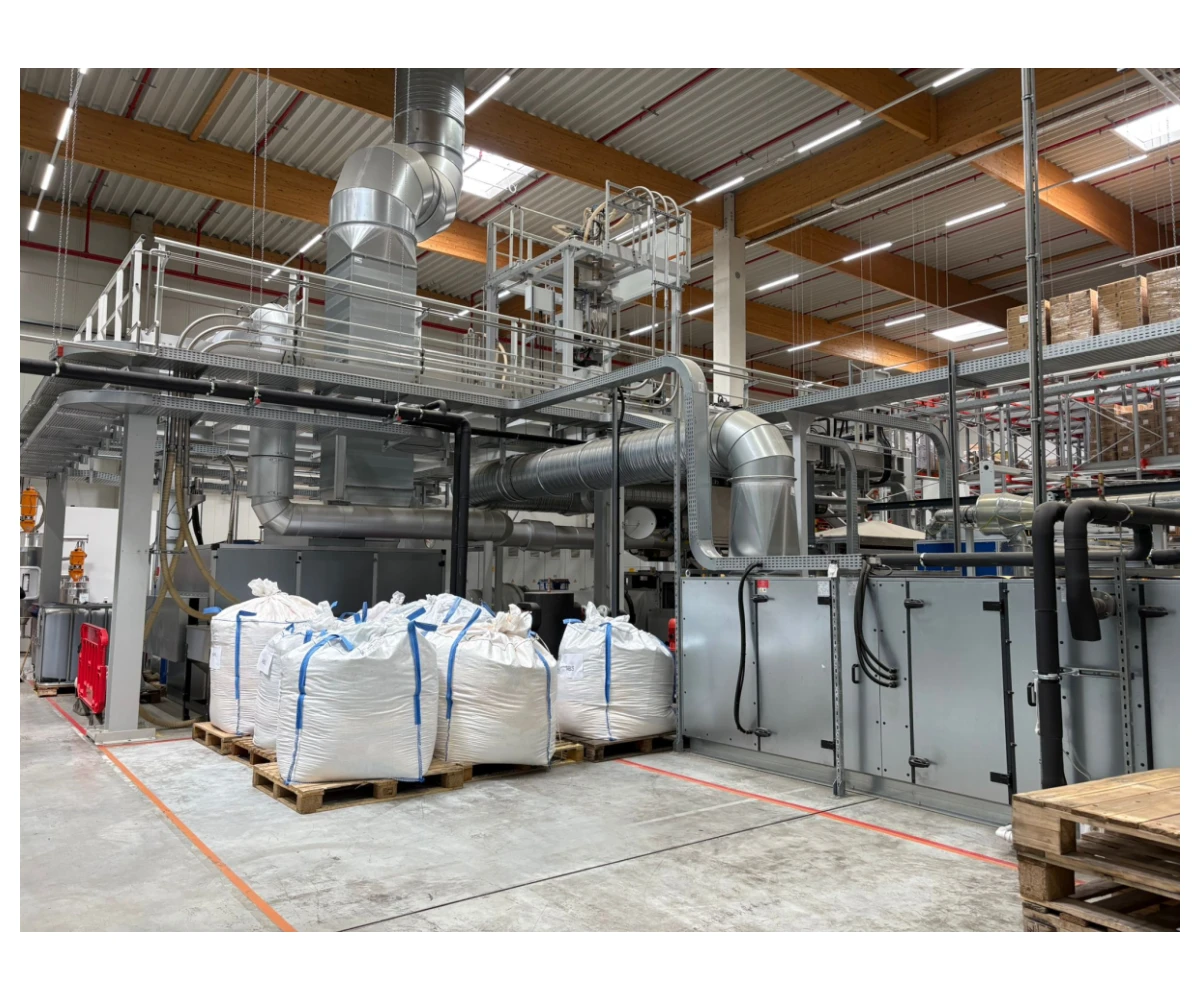
Technical specifications:
- Manufacturer: Reifenhäuser GmbH & Co. KG Maschinenfabrik
- Model: Reicofil MB 1600
- Year of production: 2021
- Last operation: 2022
- Working width: 1600 mm
- Suitable material: Polypropylene (PP), MFI 230 / 2.16 > 400 g/10 min
- Production capacity: Up to 65 kg/h per meter of width
- Product weight: 10-80 g/m²
- Production speed: 5-80 m/min
- Nozzle head: MB 1600, 50 h/inch
- Extruder: RT-1101-1-100, L/D 30
- Rotary beam heating power: 65-172 kW
- Winding station: Contact winder with automatic coil change
- Maximum winding diameter: 1250 mm
- Width Web width: 1700 mm
- Winding tension: 10–100 N/m
Additional equipment and accessories:
- 3-component dosing system
- 80 mm screen changer
- Ultrasonic cleaning system
- Pyrolysis oven
- Ozone extraction
- Cutting knife
- Central control panel with touchscreen and data storage
3. Applications of meltblown nonwovens
Nonwovens produced using meltblown technology are used wherever effective filtration of very fine contaminants is crucial. Materials produced on the Reicofil MB 1600 line are used in air and liquid filtration. It is important that they have high efficiency and low flow resistance.
Thanks to their microstructure, meltblown nonwovens are ideal as an active layer in industrial filtration systems. They are responsible for retaining dust, aerosols, and very small particles that cannot be captured by conventional filter materials.
These materials are also widely used in the medical and hygiene industries, where meltblown nonwovens act as a protective barrier. Equally important are technical applications, where parameter stability, structural repeatability, and predictable material behavior over long periods of use are crucial. In many cases, meltblown nonwovens are a key element of multilayer filter structures.
4. Why is meltblown technology so demanding?
Meltblown technology is a process particularly sensitive to changes in parameters. Polymer temperature, air velocity and temperature, and material feed stability must be maintained within very narrow ranges. Therefore, precise production, based on stable process management and advanced automation, is paramount in the Reicofil MB 1600.
Uniform fiber formation across the entire working width, grammage control, and ongoing quality control allow for consistent material properties even during long-term continuous operation. In practice, this translates into greater product repeatability and reduced material waste in the production process.
5. Reicofil MB 1600 in Industrial Production
The Reifenhäuser Reicofil MB 1600 was designed as a line for intensive industrial operation, where high performance must be combined with stable parameters. This system enables the production of large volumes of nonwoven fabrics without compromising their filtration properties.
In real-world plant conditions, this means continuous production with predictable results and consistent material quality. For companies for which nonwoven fabric production is a key part of their operations, this approach translates directly into the efficiency, reliability, and safety of the entire process.
6. Summary
The Reifenhäuser Reicofil MB 1600 is an advanced meltblown line designed for the stable and precise production of technical nonwoven fabrics in industrial environments. The combination of proven meltblown technology and constant quality control makes this system highly efficient. This makes it suitable for applications where reliability and repeatable material parameters are essential.
This line is used in both air filtration and liquid filtration systems, where the material's ability to effectively separate particles determines the functionality of the final product. The microstructure of nonwoven fabrics produced using the Reicofil MB 1600 allows for high filtration efficiency while maintaining stable performance properties.
Thanks to the precise production process and advanced automation, the line enables long-term continuous operation without compromising the quality of the produced material. This is a crucial aspect for plants that rely on uninterrupted production and predictable results.
The Reicofil MB 1600 is a solution for companies that require full control over the production process, high product repeatability, and stable operation over the long term. This technological line is designed not as a compromise, but as a tool for the most demanding filtration and technical applications.